As I repeatedly introduced before, now a lot of companies make a official account on Sina Weibo for marketing purpose. And Sina Weibo or other company provided many useful analysis report before, the report that I will introduce today also do not pale so much in comparison to them.
The report that Sina Weibo published is written about the analysis report of corporate official account tweet. And the report is divided into three main part as follows.
1. The analysis by a day of week
The orange colored line graph is the ratio of corporate official account tweet by the day of a week, and the blue colored graph is the ratio of re-tweet by users to them, and green colored graph is the ratio of comment by users to them.
This report defined as follows:
- In case of the numerical value of blue or green line is more than orange graph is the day that is suited to tweet.
- On the other hand, in case of the numerical value of orange graph is more than blue or green graph is the day that is not suited to tweet.
According to this report, Wednesday and Thursday are the suitable day for tweet, and Monday and Tuesday are not the suitable day for tweet, and Friday to Sunday is the even day.
Generally speaking, Monday and Friday is not the suitable day for promotion, but its tendency may also apply to tweet on Weibo.
2. The analysis by timezone of a day. (Weekday)
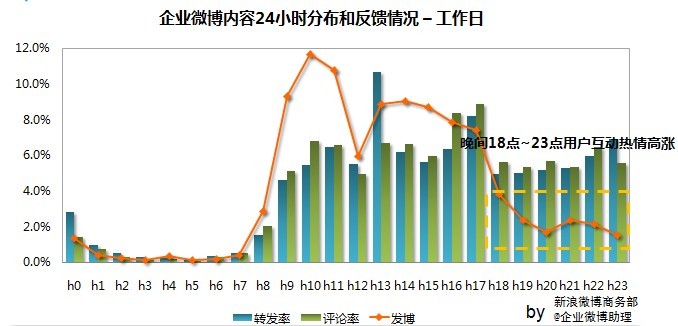
The define of this graph is also same as above.
According to this data, from 8:00 to 17:00 p.m. is not suitable to tweet, and from 18:00 to 23:00 is suitable to tweet. The report by JiaThis also said that 41% of user post the information to social media at from 18:00 to midnight 2:00, so this late time may be exactly suitable to tweet.
3. The analysis by timezone of a day. (Weekend)
This data doesn't show the remarkable point, but this report said that from 13:00 to 14:00 and from 17:00 to 23:00 of the weekend is suitable to tweet.
This data is also no more than a pointer, but I think that it is worth trying. If there were problem to tweet in the night time or weekend, don't worry about it. Because the tweet reservation system for Weibo will be able to assist you.
Source => Eguan
Writing about Social Media (SNS, WeChat, Weibo, LBS, Enterprise Social Networking and so on) and Mobile market/industry activity and their service in China and around Asia.
Wednesday, January 30, 2013
Monday, January 28, 2013
Chinese mobile SMS was substantially negative growth in 2012. WeChat or Weibo had impact on it?
MIIT released the report that is written about the summary of Chinese mobile SMS, and this report said that the number of SMS messages was 897.31 billion incidents in 2012.
This report also said that the number of Chinese SMS users are 765 million people in 2012. The number of Chinese mobile user was about 1100 million people in the end of 2012, hence it follows that about 70% of mobile users use SMS in China.
Actually SMS is the most popular method of communication by mobile phone in China, and many people use it to send the greeting at holiday or memorial day, such as Chinese new year.
But going back to the subject, the number of SMS messages was increasing only 2.1% compared to 2011. And the number of mobile phone users in China was increasing about 11% compared to the previous year, so it can be said that the number of SMS messages was substantially negative growth in 2012.
One of this reason was the rapid progress of WeChat or Weibo. Mainly young people shifted the communication method on mobile phone from SMS to WeChat or Weibo. WeChat and Weibo already each have over 300 million users, and this growth will continue in 2013. So the number of SMS messages may be truly negative growth in 2013.
Thursday, January 24, 2013
Ogilvy PR China and CIC published the updated version of “2012 Crisis Management in the Microblog Era white paper".
Last February, Ogilvy PR China and CIC co-published the report of "2012 Crisis Management in the Microblog Era white paper", and recently they published the update version of this report.
2012 crisis management in the microblog era white paper from SEEISEE
This report is written about the example of problem, solutions and proposal in case of operating the official account on Weibo.
The example on this report is divided three sections as follows;
- Public Credibility Crisis
- Personal Crisis
- Brand(Corporate) Crisis
And this report mentioned the some detail of making big impact to the society.
This report is not only written about the wrong cases, but is also written about the good cases such as above McDonald's.
After in comparison with many examples in this report, they defined the best method as follows.
- Response time is the best within 8 hours. (at least within 24 hours)
- Exective have to directly post the message to the users on Weibo.
Finally, this report proposed the principles of 3Cs and 8 basic rules as follows.
1. Be faster: respond quickly!
2. Be fully prepared: have a crisis management system in place.
3. Be alert to early signs of crisis with 24/7 monitoring.
4. Have an honest and equal dialogue: a crisis is a test of character.
5. Hearts follow minds: emotions are crucial.
6. Fame is a commodity: maintain a good relationship with relevant KOLs.
Where
7. Social readiness: practice makes perfect.
8. Integrate owned media, paid media and earned media.
All of us already know "Faster is Better" and so forth, but easier said than done. So we have to re-study from this report to make a good relationship with our fans on Weibo.
Source => CIC
This report is written about the example of problem, solutions and proposal in case of operating the official account on Weibo.
The example on this report is divided three sections as follows;
- Public Credibility Crisis
- Personal Crisis
- Brand(Corporate) Crisis
And this report mentioned the some detail of making big impact to the society.
This report is not only written about the wrong cases, but is also written about the good cases such as above McDonald's.
After in comparison with many examples in this report, they defined the best method as follows.
- Response time is the best within 8 hours. (at least within 24 hours)
- Exective have to directly post the message to the users on Weibo.
Finally, this report proposed the principles of 3Cs and 8 basic rules as follows.
1. Be faster: respond quickly!
2. Be fully prepared: have a crisis management system in place.
3. Be alert to early signs of crisis with 24/7 monitoring.
4. Have an honest and equal dialogue: a crisis is a test of character.
5. Hearts follow minds: emotions are crucial.
6. Fame is a commodity: maintain a good relationship with relevant KOLs.
Where
7. Social readiness: practice makes perfect.
8. Integrate owned media, paid media and earned media.
All of us already know "Faster is Better" and so forth, but easier said than done. So we have to re-study from this report to make a good relationship with our fans on Weibo.
Source => CIC
Wednesday, January 23, 2013
The registered users of Tencent Weibo was 540 million people as of the end of 2012.
Tencent Weibo recently held a event, and they announced there that their registered user was 540 million people as of the end of 2012.
They announced that their registered user was 507 million people by the third quarter. So in short, this means that their registered user increased 33 million people in a quarter.
And they also announced some number that is related their service as follows:
- Average active user per a day : 100,000,000 people
- Average post with picture per a day : 4,000 times
(* Half of it was posted from mobile devices.)
- The number of registered Hashtags : 9,000 issue
- Total post with emotion icon : 680,000,000 times
And Cui Yongyuan who are announcer of CCTV was elected "Tencent Weibo of the year".
Well, Tencent have 540 million users on their Weibo, and furthermore have over 300 million users on their Weixin. Their users must be overlapped for the most part, but it's the fact that this number is huge.
As I reported before, the most of Tencent's revenue was occupied by game services. But they have a huge base on their social platform now, so their profit structure may be dramatically changed in 2013. (for example, O2O advertisement on their social platform).
Source => CHINADAILY, China News, Tencent IT
They announced that their registered user was 507 million people by the third quarter. So in short, this means that their registered user increased 33 million people in a quarter.
And they also announced some number that is related their service as follows:
- Average active user per a day : 100,000,000 people
- Average post with picture per a day : 4,000 times
(* Half of it was posted from mobile devices.)
- The number of registered Hashtags : 9,000 issue
- Total post with emotion icon : 680,000,000 times
And Cui Yongyuan who are announcer of CCTV was elected "Tencent Weibo of the year".
Well, Tencent have 540 million users on their Weibo, and furthermore have over 300 million users on their Weixin. Their users must be overlapped for the most part, but it's the fact that this number is huge.
As I reported before, the most of Tencent's revenue was occupied by game services. But they have a huge base on their social platform now, so their profit structure may be dramatically changed in 2013. (for example, O2O advertisement on their social platform).
Source => CHINADAILY, China News, Tencent IT
Monday, January 21, 2013
The sales scale of group-buying in China was about 3.41 billion USD in 2012. The cumulative total number of its users were 456 million people. [Infographic]
Portal site of group-buying "Tuan800" reported the summary of group-buying industry in China as follows.
Total revenue of its industry was 3.41 billion USD in 2012, and it was increasing 93% compared to 2011.
And the cumulative total number of users were 456 million people, and it was increasing 45% compared to 2011.
And the breakdown of this revenue is as follows:
- Food and Drink 1.525 billion USD (44.72%)
- Leisure 0.771 billion USD (22.61%)
- Life 0.413 billion USD (12.11%)
- Brand items 0.344 billion USD (10.09%)
- Travel 0.293 billion USD (8.59%)
- Other 0.064 billion USD (1.88%)
Next is the sales ratio by each cities.
- 1st level cities 22.85%
- 2nd level cities 22.50%
- Other 46.47%
The revenue ratio of the 3rd level cities and under was 19.89% in 2011, so its number in 2012 was increasing over twice compared to 2011.
Total revenue of its industry was 3.41 billion USD in 2012, and it was increasing 93% compared to 2011.
And the cumulative total number of users were 456 million people, and it was increasing 45% compared to 2011.
And the breakdown of this revenue is as follows:
- Food and Drink 1.525 billion USD (44.72%)
- Leisure 0.771 billion USD (22.61%)
- Life 0.413 billion USD (12.11%)
- Brand items 0.344 billion USD (10.09%)
- Travel 0.293 billion USD (8.59%)
- Other 0.064 billion USD (1.88%)
Next is the sales ratio by each cities.
- 1st level cities 22.85%
- 2nd level cities 22.50%
- Other 46.47%
The revenue ratio of the 3rd level cities and under was 19.89% in 2011, so its number in 2012 was increasing over twice compared to 2011.
Meituan and Dianping is the two top of this industry in China, and their sales revenue was more than 500 million USD in 2012.
Lashou, Nuomi and 55tuan are the second group of this industry, and their sales revenue was each from 320 to 500 million USD in 2012.
GaoPeng(高朋) is the subsidiary of Groupon in China. They belong to the third group of this industry in China, but it have to say that they still have their back against the wall in China.
Group-buying industry in China will be still growing in 2013 too. But on the other hand, the curtailment of supplier already started from last year.
I would like to introduce the structure and the detail of this industry in near future.
Source => Eguan
Source => Eguan
Wednesday, January 16, 2013
China's national average of internet utilization was still 42.1% in the end of 2012. So there is a lot of chance in Chinese internet market still now.
Yesterday, I introduced the summary of "The 31th Statistical Report on Internet Development in China" by CNNIC. And this report said that the internet users in China were 564 million people, and mobile internet users in China were 420 million people as of the end of 2012.
So, I will introduce the three detailed matters of this report today.
1. The diffusion rate of internet by area in China.
The top 5 cities of diffusion rate:
#1 Beijing 72.2%
#2 Shanghai 68.4%
#3 Guangdong 63.1%
#4 Fujian 61.3%
#5 Zhejiang 59.0%
National average 42.1%
The top 5 cities of the growth rate:
#1 Ningxia 24.5%
#2 Guizhou 17.9%
#3 Anhui 17.9%
#4 Guangxi 17.2%
#5 Jiangxi 16.5%
National average 9.9%
Watching this data, we can understand that China is not the one big market, and China is the aggregate of each many small(but actually big) markets. Each cities have the difference of diffusion rate, growth rate and its circumstance. I think that still exists a lot of chance at the inland areas of China in future.
2. User number and utilization rate by each internet services in China.
The top place of user number and utilization was still Instant Messenger as same as the end of 2011. WeChat is rapidly growing as I said before, and QQ also continue to reign as the king of internet services in China still now.
And "Search" is the second place in this data. Baidu still dominate about 65% of this market as I explained before, Qihoo 360 is magnifying their market share from second half of the last year. So the battle of this market is worth for keeping eye on this year.
Weibo and SNS was each ranked seventh place and eighth place. The growth rate of Weibo users were 23.5%, but this number is dramatically down compared to the end of 2011(296%). As I explained before, this year is still the challenge year regarding Weibo.
And other remarkable point is that email utilization is still less than Weibo or SNS. I explained before that Enterprise Social Networking is suitable to using in China, but this is also one of the evidence for this.
3. The user number and utilization of each mobile internet services.
In this data, there are 5 mobile internet services that growth rate was over than 5% compared to the last year as follows.
* Mobile Search 62.1% -> 69.4%
* Mobile Weibo 38.5% -> 48.2%
* Mobile Online Video 22.5% -> 32.0%
* Mobile Online Shopping 6.6% -> 13.2%
Especially Mobile Weibo user was increasing about 65.51 million people compared to the end of 2011, and their users number was 202.41 million people in the end of 2012.
So it can be said that "Mobile Solution" and "Overseas deployment" are very important key factor for Weibo this year.
Source => CNNIC
So, I will introduce the three detailed matters of this report today.
1. The diffusion rate of internet by area in China.
The top 5 cities of diffusion rate:
#1 Beijing 72.2%
#2 Shanghai 68.4%
#3 Guangdong 63.1%
#4 Fujian 61.3%
#5 Zhejiang 59.0%
National average 42.1%
The top 5 cities of the growth rate:
#1 Ningxia 24.5%
#2 Guizhou 17.9%
#3 Anhui 17.9%
#4 Guangxi 17.2%
#5 Jiangxi 16.5%
National average 9.9%
Watching this data, we can understand that China is not the one big market, and China is the aggregate of each many small(but actually big) markets. Each cities have the difference of diffusion rate, growth rate and its circumstance. I think that still exists a lot of chance at the inland areas of China in future.
2. User number and utilization rate by each internet services in China.
The top place of user number and utilization was still Instant Messenger as same as the end of 2011. WeChat is rapidly growing as I said before, and QQ also continue to reign as the king of internet services in China still now.
And "Search" is the second place in this data. Baidu still dominate about 65% of this market as I explained before, Qihoo 360 is magnifying their market share from second half of the last year. So the battle of this market is worth for keeping eye on this year.
Weibo and SNS was each ranked seventh place and eighth place. The growth rate of Weibo users were 23.5%, but this number is dramatically down compared to the end of 2011(296%). As I explained before, this year is still the challenge year regarding Weibo.
And other remarkable point is that email utilization is still less than Weibo or SNS. I explained before that Enterprise Social Networking is suitable to using in China, but this is also one of the evidence for this.
3. The user number and utilization of each mobile internet services.
In this data, there are 5 mobile internet services that growth rate was over than 5% compared to the last year as follows.
* Mobile Search 62.1% -> 69.4%
* Mobile Weibo 38.5% -> 48.2%
* Mobile Online Video 22.5% -> 32.0%
* Mobile Online Shopping 6.6% -> 13.2%
Especially Mobile Weibo user was increasing about 65.51 million people compared to the end of 2011, and their users number was 202.41 million people in the end of 2012.
So it can be said that "Mobile Solution" and "Overseas deployment" are very important key factor for Weibo this year.
Source => CNNIC
Tuesday, January 15, 2013
The report by CNNIC said that the number of internet users in China reached 564 million people as of the end of 2012.
Yesterday, CNNIC released "The 31th Statistical Report on Internet Development in China", and this report said that the number of internet users in China reached 564 million people as of the end of 2012.
Its number was increasing about 50,900,000 people compared to the end of 2011.
The diffusion rate of internet was 42.1%, and this number was increasing 3.8% compared to the end of 2011.
Next, mobile internet users in China reached 420 million people as of the end of 2012.
Its number was increasing about 64,000,000 people compared to the end of 2011. And this increase number was larger than the whole internet users.
And the sex ratio of internet user was 56%(men) and 44%(women), and the ratio by age was occupied over than 70% by the age of from 10 to 39.
And the device ratio of connecting to the internet was as follows.
2011 2012 Rate of Change
Desktop PC 73.4% 70.6% -2.8%
Mobile PC 46.8% 45.9% -0.9%
Mobile Devices 69.3% 74.5% +5.2%
And the average time of connecting to the internet was 20.5 hours in a week, and this number was increasing 1.8 hours compared to the end of 2011.
Today, I introduced the summary of this report. And I will introduce the detail of this report such as the number by each internet services and so forth tomorrow. Don't miss it :)
Source => CNNIC, SohuIT
Its number was increasing about 50,900,000 people compared to the end of 2011.
The diffusion rate of internet was 42.1%, and this number was increasing 3.8% compared to the end of 2011.
Next, mobile internet users in China reached 420 million people as of the end of 2012.
Its number was increasing about 64,000,000 people compared to the end of 2011. And this increase number was larger than the whole internet users.
And the sex ratio of internet user was 56%(men) and 44%(women), and the ratio by age was occupied over than 70% by the age of from 10 to 39.
And the device ratio of connecting to the internet was as follows.
2011 2012 Rate of Change
Desktop PC 73.4% 70.6% -2.8%
Mobile PC 46.8% 45.9% -0.9%
Mobile Devices 69.3% 74.5% +5.2%
And the average time of connecting to the internet was 20.5 hours in a week, and this number was increasing 1.8 hours compared to the end of 2011.
Today, I introduced the summary of this report. And I will introduce the detail of this report such as the number by each internet services and so forth tomorrow. Don't miss it :)
Source => CNNIC, SohuIT
Subscribe to:
Posts (Atom)


